
ED After 40: Why It Shows Up and What Actually Helps
Turning forty does not switch anything off. It does narrow the margin for error — and that margin is where most men first notice a difference.
Most men in their forties who start looking into erectile dysfunction describe the same thing: nothing dramatic happened. There was no single night that changed everything. Erections simply became a little less automatic, a little more dependent on circumstance, and a little slower to return after the first one. That description is so common it is almost a clinical signature, and it points at something specific about how erections work.
An erection is a plumbing event with a nervous-system trigger
Arousal signals the smooth muscle lining the arteries of the penis to relax. Relaxed arteries let blood rush into two spongy chambers, the corpora cavernosa. As those chambers swell they press outward against a tough sheath of tissue, and that pressure pinches the veins that would normally drain the blood away. Blood goes in easily, cannot leave easily, and the result is rigidity. Every part of that chain is physical.
The chemical that keeps the arteries relaxed is cyclic GMP. An enzyme called PDE5 breaks cyclic GMP back down, which is how an erection ends. In a twenty-five-year-old the production of cyclic GMP so completely outpaces the enzyme clearing it that the balance is never in question. In a forty-five-year-old the two sides are closer together, and that is the whole story of most age-related change.
What actually shifts in the fourth decade
Three things drift at once, and none of them individually would be enough to notice.
Arterial responsiveness declines. The endothelium — the single-cell lining of every blood vessel — produces the nitric oxide that starts the cyclic GMP cascade. Endothelial function is measurably lower at forty-five than at twenty-five in men who are otherwise healthy, and considerably lower in men with high blood pressure, high cholesterol, elevated blood sugar or a smoking history. The penile arteries are among the narrowest in the body, roughly a millimetre across, which is why they register vascular change before the coronary arteries do.
The venous seal gets less reliable. The connective tissue that traps blood inside the chambers loses some of its elasticity over time. Blood still enters normally; it just leaks away sooner. Men experiencing this describe getting hard without difficulty but losing firmness partway through, particularly when they change position.
The refractory period lengthens. The gap between one erection and the next stretches from minutes to hours. This is a normal, universal change and has no treatment because it needs none.
The part nobody warns you about
Because the underlying shift is gradual, the first genuine failure usually arrives as a surprise, and surprise is what turns a mechanical issue into a recurring one. The next time, a portion of attention is spent monitoring whether it is going to happen again. That monitoring is sympathetic nervous system activity, and sympathetic activity constricts the exact arteries that need to dilate. The physical margin was already narrower; anxiety eats what is left.
This is why men are often told the problem is "in your head" and why that framing is so unhelpful. The anxiety is real and it is doing real vasoconstriction, but it is almost always a response to a physical change rather than the origin of it. Treat the physical side and the anxiety usually resolves on its own, because the evidence it was feeding on disappears.
What is worth checking before you treat anything
ED in a man over forty is one of the more useful symptoms in medicine, because it frequently precedes a cardiovascular diagnosis by three to five years. Anyone in this position should know their blood pressure, their fasting glucose or HbA1c, and their lipid panel. Low testosterone is worth testing if libido has dropped alongside function, though it is a less common cause than most men assume. Certain medications — particularly some blood pressure drugs, SSRIs and finasteride — are also worth reviewing with whoever prescribed them.
None of this means treatment has to wait. It means the symptom deserves a real conversation rather than being treated as a standalone inconvenience.
Where prescription treatment fits
PDE5 inhibitors work by slowing the enzyme that clears cyclic GMP. They do not create arousal and they do not create an erection on their own — without the nitric oxide signal there is nothing for them to preserve. What they do is widen the margin back out, so a normal amount of arousal produces a reliable result again. For a man in his forties whose vascular function has drifted rather than collapsed, that is usually all that is required.
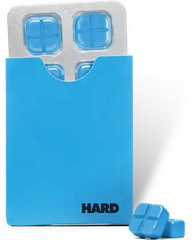
HardRx combines sildenafil and tadalafil in one sublingual tablet that dissolves under the tongue. Sildenafil is the faster of the two; tadalafil has the longer tail. The intended effect of the pairing is a shorter wait at the start without the window closing early. Because it dissolves rather than being swallowed, it is not competing with a meal for absorption — a practical difference if dinner is part of the evening.
The habits that genuinely move the needle
Endothelial function responds to behaviour more than most tissue in the body, and it responds within weeks rather than years. Regular aerobic exercise is the single most reliable intervention studied. Stopping smoking produces measurable arterial improvement inside three months. Losing visceral fat lowers the inflammation and aromatase activity that both work against you. Sleeping seven hours matters more than most men expect, which is the subject of a separate article.
These are not alternatives to treatment. Medication handles tonight; the habits determine whether you still need medication in five years. Most men do best running both.
The honest summary
ED after forty is common, it is mechanical, and it is treatable. It is not a verdict on your masculinity, your relationship or your future. It is a narrower margin in a system that used to have margin to spare — and both prescription treatment and unglamorous lifestyle work widen that margin from different directions.
Common Questions
No. Population studies consistently find that a meaningful share of men in their forties experience erectile difficulty at least sometimes. It becomes more common each decade, but forty is well inside the normal range for it to appear.
Usually not. Low testosterone typically reduces desire before it affects function. If your libido is intact and the issue is mechanical, vascular causes are far more likely. A blood test settles it either way.
Not necessarily. Many men use treatment while addressing blood pressure, weight, sleep or fitness, and find they need it less often as those improve. Others use it long term. Both are reasonable outcomes.
Often yes, but it depends entirely on which medication. Nitrates are an absolute contraindication. Some alpha-blockers require dose separation. List everything you take on the assessment and the reviewing physician will make that call.
Ready when you are
A five-minute assessment, a licensed physician, and free discreet delivery.
Safety & Important Information
Take only the dose you were prescribed, and never more than one in any 24-hour period. HardRx is not suitable if you take nitrates or have certain heart conditions. Side effects are usually mild and may include headache, flushing, dizziness or nasal congestion. Nothing on this page replaces professional medical advice — read the full safety information before ordering.
Take Control Today With HardRx
More performance. More confidence. A better you.